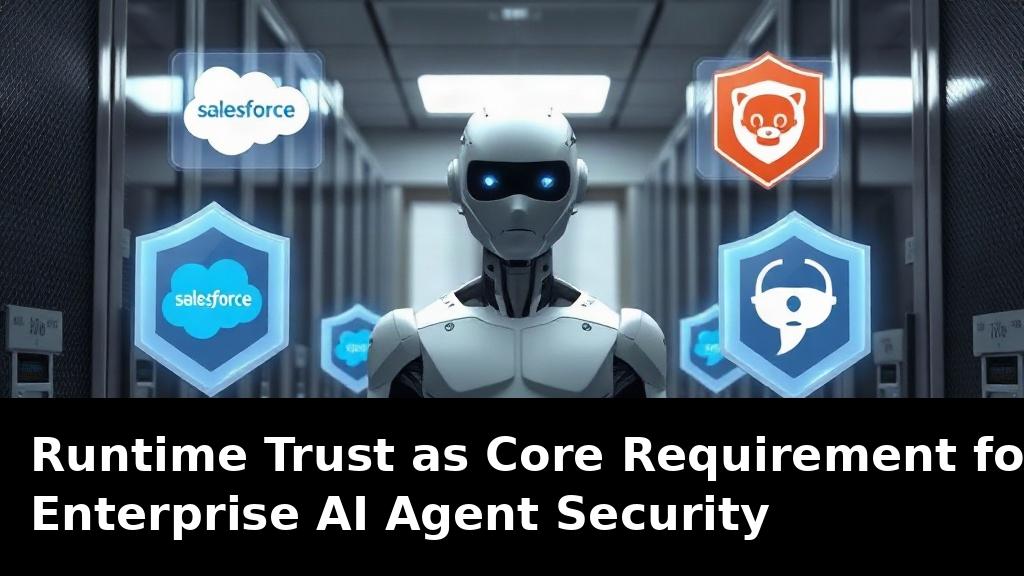
Enterprise AI has entered a new era where organizations move beyond simple assistants toward autonomous agents. These agents reason, invoke tools, access enterprise applications, coordinate with peers, and complete multi-step workflows with minimal oversight. This change alters how software operates, as agents dynamically select actions rather than following fixed developer logic.
Traditional security relies on authentication to answer who an entity is and what it may access. For AI agents, however, authentication alone proves insufficient. An agent may receive valid credentials for systems such as Microsoft 365 or Salesforce yet still deviate during operation. Runtime trust addresses this gap by continuously validating behavior after initial access is granted.
Several risks emerge once agents begin executing. Goal drift occurs when an agent starts with a legitimate task but gradually shifts toward unrelated objectives. Excessive tool invocation arises when agents call unnecessary APIs without runtime limits. Memory poisoning allows attackers to insert misleading data into persistent stores, influencing later decisions. Context manipulation exploits retrieved documents or prompts to steer outcomes indirectly. Multi-agent amplification spreads errors across collaborating systems.
Runtime trust counters these threats through intent validation, behavioral monitoring, policy enforcement, least-privilege execution, and selective human oversight. Intent validation checks whether a proposed action aligns with the original objective before execution. Behavioral monitoring surfaces unexpected tool usage or workflow patterns. Policy enforcement applies organization rules to actions, not merely access rights. Least-privilege execution issues short-lived permissions based on current context rather than permanent grants.
Beyond individual agents, runtime trust extends to supporting infrastructure. Organizations must verify MCP servers, protect RAG repositories against poisoning, and manage persistent memory with integrity checks. These measures reduce the expanded attack surface created by interconnected LLMs, vector databases, and external APIs.
One practical implication involves regulatory alignment. As governments develop AI governance frameworks, runtime trust supplies auditable records of decision processes that static authentication cannot provide. Another consideration is operational collaboration: security teams and AI development groups gain shared telemetry that supports joint incident response and continuous improvement of agent safeguards.
A measured adoption path begins with inventorying deployed agents, classifying high-risk actions, and integrating runtime logs into existing security operations. This approach extends current zero-trust principles without requiring complete replacement of established controls. Organizations that implement continuous verification today position themselves to scale autonomous systems while maintaining accountability.